
Climbing Kilimanjaro via the popular 7-day Machame Route
Mount Royal Safaris: The Magnificent Machame Route
The Most Scenic Ascent What could possibly be better than climbing Mount Kilimanjaro? Conquering it via the Machame Route—widely celebrated as the most scenic and breathtaking climbing route in the world! Prepare yourself for stunning panoramic views of Mount Meru, an exhilarating hike up the famous Barranco Wall, and beautifully maintained trails. Because this route utilizes a different path for the descent, you get to experience an incredible diversity of flora and landscapes. It is truly two spectacular journeys in one!
Simply immerse yourself in this wonderful adventure and take in the view once you finally reach the summit—it is a triumphant moment you will carry with you for the rest of your life.
The Mount Royal Safaris Advantage Climbing Kilimanjaro is the ultimate challenge, and at Mount Royal Safaris, we know that the little details can make a world of difference. That is why you will climb alongside our dedicated team of professional guides, hardworking porters, and a highly skilled mountain cook.
Our team takes exceptional care of you throughout your Machame ascent by conducting thorough health checks twice a day and serving you delicious, energizing meals. Sounds like a bit much? Not if your goal is to stand on the Roof of Africa! We understand that altitude sickness can creep up unnoticed, and that proper, high-quality nutrition is absolutely essential to keep you going strong during such a strenuous climb.
Climb With Confidence Furthermore, Mount Royal Safaris provides a comprehensive information package to ensure you are completely prepared for your Machame adventure. It includes essential details about Tanzania, Mount Kilimanjaro, the best training strategies, and exactly what gear you will need to buy or rent.
A Commitment to Ethical Climbing We are incredibly proud to be a partner of the Kilimanjaro Responsible Travel Organisation (KRTO). This means we take exceptional care of our hardworking crew and fiercely protect the mountain environment, ensuring you can climb with a completely clear conscience.
Are you ready for an unforgettable experience with Mount Royal Safaris?
Itinerary
Discover Tanzania With Mount Royal Safaris
Your Dream Adventure Awaits Exploring all that Tanzania has to offer is a dream for many. From epic safari adventures spotting Africa’s iconic Big Five, to conquering the majestic Mount Kilimanjaro, to unwinding on the paradise beaches of Zanzibar: Tanzania truly has it all. The good news? Mount Royal Safaris can design a custom-made itinerary perfectly tailored to all your wishes.
Find Your Inspiration Our most popular itineraries are the perfect place to find some inspiration for your trip. Many of our guests love to conclude their thrilling adventure with a few days of relaxation on one of Zanzibar’s stunning, white-sand beaches. Would you like to add a tropical escape to your itinerary as well?
Travel At Your Own Pace Whether you choose one of our expertly crafted Mount Royal itineraries or prefer to fully customize your journey from scratch, our dedicated team is here to assist you every step of the way. Come aboard with Mount Royal Safaris and get ready to explore Tanzania at your own pace, exactly the way you have always imagined!
Welcome to Tanzania Upon your arrival at Kilimanjaro International Airport, your dedicated Mount Royal Safaris guide will be eagerly waiting to welcome you. You will then be smoothly transferred to your comfortable hotel, where you can fully unwind and relax after your flight.
Preparation for Your Climb Before you begin your ascent, you will have a comprehensive meeting with your expert mountain guide. During this essential briefing, they will offer personalized advice on what to wear, exactly what to pack, and share other invaluable tips to ensure your upcoming climb with Mount Royal Safaris is as safe, successful, and comfortable as possible.
Entering the Rainforest In the morning, your dedicated Mount Royal Safaris guide will pick you up from your hotel and transfer you to the Machame Gate, where your unforgettable Kilimanjaro climb officially begins! As you begin your ascent through the mountain's stunning lower slopes, you will watch the lush, dense rainforests gradually transition into beautiful heather moorlands.
Arrival at Machame Camp After a rewarding five to six-hour hike, you will arrive at your first overnight stop: Machame Camp, uniquely situated right on the edge where the vibrant forest meets the heath zone. Since this is your first day adjusting to the new altitude, our team will be there to gently remind you of the golden rule on the mountain: always remember to drink plenty of water!
A Rewarding Climb Your second day on the mountain with Mount Royal Safaris begins with a steady and slightly steeper climb. Along the trail, your guide will lead you to a striking circular cliff affectionately known as Picnic Rock. Here, your morning efforts are rewarded with truly stunning, panoramic views of Kibo (Kilimanjaro's main summit) and the jagged ridges of Shira (one of the mountain's older volcanic peaks).
Rest and Acclimatization From Picnic Rock, you will continue your hike along a beautifully scenic route until you reach the expansive Shira Camp. Upon arrival, a hot, nourishing lunch prepared by our team awaits, giving you ample time to rest and recharge. In the afternoon, if you are feeling up to it, we highly recommend joining your guide for an optional acclimatization walk towards the impressive Lava Tower. This short, 2-kilometer trek takes you up to an altitude of 4,630 meters, significantly aiding your body's crucial adjustment to the higher elevation.
Navigating the High Altitude Departing from Shira Camp, your Mount Royal Safaris guide will lead you on a remarkable trek toward the iconic Lava Tower for a well-deserved lunch break. This segment of the journey features a series of rolling ascents and descents, offering absolutely breathtaking panoramic views along the way. Because this is a longer hike and you are reaching much higher elevations, it is crucial to find a steady, comfortable pace. You might begin to feel the effects of the thinner air today, but our expert team will be right by your side to monitor your progress, encourage you, and ensure you are adapting safely.
Arrival at Barranco Camp After enjoying a hot, nourishing lunch prepared by our team at the Lava Tower, you will begin a scenic descent down to Barranco Camp. Your home for the night is spectacularly situated right at the base of the famous Barranco Wall—a striking natural marvel that will leave you in awe of both its immense size and dramatic steepness.
Scaling the Wall After a hearty breakfast prepared by our Mount Royal Safaris culinary team, you will depart from Barranco Camp and set your sights on the famous Barranco Wall. Though it looks intimidating, scaling this impressive rock face is actually a fun scramble and, for many of our climbers, the absolute highlight of the entire journey! As you safely navigate the wall with the close, hands-on guidance of our experts, you will be rewarded at the top with truly spectacular, sweeping views of the Kibo Volcano and the distant Mount Meru.
The Trek to Karanga Following this morning triumph, a more challenging segment begins as you make your way toward Karanga Camp. This undulating trail features a series of ascents and descents, making it essential to maintain a slow and steady pace—pole pole, as we say in Tanzania! Upon arriving at Karanga Camp, a hot, well-deserved lunch will be waiting for you. After a restful afternoon, you have the option to join your guide for a short but highly beneficial acclimatization hike in the direction of Barafu Camp, ensuring your body is perfectly primed for the days ahead.
The Descent and Recovery After taking the time to celebrate this incredible, once-in-a-lifetime achievement and capture your summit photos, your descent begins. The Mount Royal team will guide you safely back down through Kibo Camp for a short rest before continuing the descent to the Horombo Huts. There, a hot, celebratory dinner and a well-earned overnight sleep await.
In total, you will be on your feet for about twelve hours today. Prepare yourself for a physically demanding trek, but rest assured that with the unwavering support of our crew, it will be the most deeply rewarding day of your life!
The Approach to the Summit Today, your Mount Royal Safaris journey takes you to the stark and dramatic Barafu Camp, the thrilling starting point for your ultimate ascent to Uhuru Peak—the very top of Kilimanjaro! Guided by our experienced team, you will arrive at this high-altitude base camp right around lunchtime.
Rest and Final Preparations After enjoying a hot meal and taking essential time to rest and regain your physical strength, we highly recommend joining your guide for a short acclimatization hike up to Kosovo Summit Camp (4,870m) and back. From this incredible vantage point, you can take in breathtaking, panoramic views of the surrounding volcanic peaks.
As the sun sets, you will truly experience the exhilarating thrill of high-altitude camping. Settle into your tent, stay warm, and try to catch some sleep—your expert Mount Royal team will be waking you around midnight for the final, triumphant push to the summit!
The Push to the Roof of Africa The big day has finally arrived! Around midnight, under a canopy of stars, your dedicated Mount Royal Safaris team will gently wake you to begin the final, thrilling ascent from Barafu Camp to Uhuru Peak. While the trail ahead is well-defined, the most significant challenge tonight is the extreme high altitude. Rest assured, our expert guides will set a steady, manageable pace, walking right beside you to ensure you navigate this demanding stretch safely and confidently.
A Sunrise Like No Other As you push through the final steps and officially reach the summit, all of your hard work will be rewarded with a breathtakingly beautiful sunrise—a truly awe-inspiring spectacle to witness from the very highest point in Africa! Take a moment to celebrate this ultimate triumph, capture your hard-earned summit photos, and revel in the incredible, emotional achievement of conquering Mount Kilimanjaro.
The Journey Down After spending a short, exhilarating time at the top, your guides will lead you safely on a slow and careful descent back down the mountain. Your destination for the evening is the incredibly scenic Millennium Camp, where a hot, celebratory meal and a deeply deserved, restful sleep await you.
A Morning of Triumph Millennium Camp is beautifully nestled within the lush, tropical rainforest. When you wake up this morning with Mount Royal Safaris, you will feel a profound sense of physical relief from the much lower altitude, paired with an immense, glowing satisfaction from successfully conquering the summit the day before.
The Journey Home After enjoying a final, celebratory mountain breakfast prepared by our crew, you will embark on a gentle and incredibly scenic walk down to the Mweka Gate, the official exit of Kilimanjaro National Park. Here, you will officially sign out and receive your hard-earned summit certificate!
A Well-Deserved Rest Once at the gate, your dedicated Mount Royal Safaris driver will be waiting to welcome you back and transfer you comfortably to your hotel for a hot shower and a truly well-deserved rest. As you reflect on your journey, you will leave the mountain carrying unforgettable memories, visions of breathtaking views, and a profound, life-changing sense of accomplishment that will stay with you forever!
Until We Meet Again Sadly, your magnificent Kilimanjaro adventure has come to an end, and it is time to prepare for your journey home. We encourage you to savor your final hours in Tanzania, relaxing and reflecting on your incredible achievement, before your dedicated Mount Royal Safaris driver arrives to smoothly escort you to Kilimanjaro International Airport.
Extend Your African Dream Still longing for more of what Africa has to offer? The adventure does not have to stop here! With Mount Royal Safaris, it is effortlessly simple to extend your trip by adding a thrilling, multi-day wildlife safari or a serene, sun-drenched holiday on the pristine beaches of Zanzibar. Simply reach out to our team, and we will flawlessly arrange the ultimate continuation of your Tanzanian getaway.
Include/ Exclude
Includes
- Park fees
- 9 days
- Pickup and transfer airport
- Porters who carry your luggage
- Private cook speaking fluently English
- Private guide speaking fluently English
- Chairs and tables for breakfast, lunch and dinner
- High quality tents (including dinner-tent)
- Portable toilet
- Rescue fee (up to 11.483 feet above sea level by car)
Excludes
- Visas
- Travel insurance
- International flights (can be booked for you on request)
- Accommodation on day of arrival and departure
- Tips for guides, porters and cooks
Frequently Asked Questions
FAQs
The best time to visit Tanzania depends on what you want to see, where you want to go, your budget, and your interests. Every time of the year has its pros and cons. Here’s a guide to help you decide the best time for your Tanzanian adventure. Oh, and before we forget…Everyone is different, there is no correct choice. But one thing that’s for sure: A Tanzania Travel is beautiful the whole year!
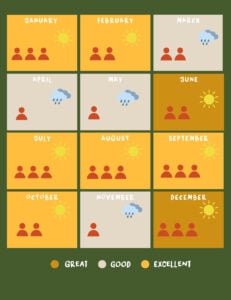
The best months: June to October & December to February
These months are the crème de la crème for visiting Tanzania! That’s why we rated them ‘Excellent’. Think of June to October as nature’s blockbuster season: sunny skies, wildlife galore, and the epic wildebeest migration. December to February is like hitting the safari jackpot, with lush green landscapes and adorable baby animals everywhere. And hey, March, April, May, and November are also cool to go—if you love vibrant greenery, bird-watching, and having the park almost to yourself, those months are a hidden gem. Yes, there might be rain, but still!
June to October (Dry Season)
This period offers the best wildlife viewing as animals gather around waterholes, with July and August being peak times for witnessing the dramatic wildebeest migration and river crossings; the weather is pleasant and sunny.
December to February (Dry Season)
The dry season continues, providing excellent game viewing opportunities and pleasant weather; January and February are particularly special for witnessing the calving season in the southern Serengeti, attracting many predators…👀
March (Rainy Season)
The rains begin, making the landscape vibrant and lush, with excellent bird watching and fewer tourists for a more intimate safari experience. And lower prices, of course!
April to May (Rainy Season)
Heavy rains make some roads challenging, but the scenery is spectacular, and the parks are quiet with lower rates, offering a serene and affordable safari experience.
November (Rainy Season)
Short rains start, rejuvenating the landscape with blooming flowers and green forests, while still offering good wildlife viewing in the northern parks. It is also generally less busy.
Tanzania weather differs from region to region – but there is always a great time to travel in Tanzania! Weather in the coastal areas is the hottest and most humid, while the North and highlands of Tanzania are cooler because of altitude. The temperatures vary between 22°C and 31 °C throughout the year. During the night, the temperature in Tanzania drops to between 10°C and 22°C. The beaches of Zanzibar have a distinctively tropical climate since it is located close to the Equator.
Tanzania weather: the seasons
Tanzania has two seasons yearly: the wet and the dry season. The wet season (also called the rainy season) runs from the end of October right through to December, and then again from the end of March to the beginning of June. They are referred to as the ‘short-’ and ‘long rains’. These tropical rains mostly start late afternoon and continue all night till early morning. The rains of Africa are famous worldwide and are a soothing, enchanting sight to behold during a trip to Tanzania!
Can I go on safari during the rainy season?
Did you know that National Geographic, Discovery and other major media companies choose the rainy season to shoot their wildlife documentaries in Tanzania? Tanzania weather is fantastic all year round and though heavy rains persist most afternoons in the rainy season, the natural environment comes to life. Nature is colourful, the grass is lush and green, beautiful flowers grow, animals find plenty of food, temperatures are nice and cool and, better yet, the main highlights of Tanzania are far less crowded with tourists.
Another benefit of travelling in rainy reason is the lower costs of safaris and accommodation during this low season. The disadvantages of travel during the wet season are that some accommodations are closed and the (sometimes) poor road conditions. Fortunately, this mainly concerns the roads in the national parks in South Tanzania.
For those travelling to Tanzania during the rainy season, the following national parks are open and ready for your visit. Serengeti, Ngorongoro Crater, Tarangire, Lake Manyara, Lake Natron and Arusha National Park. The national parks of Tanzania that are better avoided during the wet season include Nyerere, Ruaha, Mikumi & Udzungwa. So if any of the latter destinations are on your must-do list in Tanzania, be sure to head out in dry season.
These are average figures and may vary depending on the region.
How does Tanzania weather affect wildlife?
The rain makes for a lush landscape with a high concentration of animals. This means plenty of opportunities to spot wildlife at their finest – and happiest! During the rainy seasons, animals are more active which makes for a fantastic safari experience. With an abundance of food and fresh water, animals roam in their thousands. The rain also protects the animals from the harsh heat of the sun.
Many of our safari guests say that the rainy season offers a more intimate safari experience. For bird lovers, the rainy season is a fantastic time of year to visit Tanzania as lots of migratory birds arrive.
For more detailed information on Tanzania weather and when you should travel to Tanzania, check out our page on the best time to visit Tanzania.
With almost a decade of experience, we’re proud to be able to offer customised Tanzania travel advice that is second-to-none. Here we answer your top questions regarding need-to-know Tanzania travel advice.
Is Tanzania safe to travel?
”I want to visit Tanzania, but is it safe?” This is a question that regularly comes up from our clients seeking Tanzania travel advice. The short answer? Yes! Tanzania is one of the safest destinations in Africa, with more than 1 million tourists visiting the country every year.Travelling with the travel experts at Tanzania Specialist, safety is paramount. Our private safari experiences with knowledgeable, professional guides enhance your experience in Tanzania and ensure your total peace of mind.Check out our Tanzania safety tips for more information on safe travel in Tanzania.
What is the population of Tanzania?
The population of Tanzania is almost 60 million. One of Africa’s most ethnically diverse countries, around 125 different ethnic groups live in Tanzania, with more than 100 different languages spoken nationwide.
The Tanzanian people are well-known for their hospitality, often warmly welcoming tourists to experience their beautiful nature, wildlife and culture. Meeting the locals is one of the best ways to really learn more about a country and its culture and is well recommended on your Tanzania discovery!
Do I need a visa for Tanzania?
Most international travellers will need a visa to travel to Tanzania. Your visa can be requested online through the official visa website from the Tanzanian government. Please note that this is the only official link for Tanzania visa applications.
It is also possible to get a tourist or business visa for a single entry on arrival at the main ports of entry to Tanzania. This visa for Tanzania is valid for three months. You may be asked to provide proof of your return journey, and costs are $50 per person, US Citizens $100 per person.
When arranging your trip to Tanzania with Tanzania specialist, we guide you through every step of the visa and administration process.
Passport requirements
Passports should have at least six months of validity after the final day of travel.
Safety First: Don’t forget your Travel Insurance
When it comes to embarking on your dream adventure to Tanzania, your safety is our top priority! That’s why we urge all travelers to ensure they have comprehensive travel insurance in place before setting off. While Tanzania Specialist doesn’t provide travel insurance directly, we’re delighted to recommend Chapka Travel Insurance as your go-to provider for your upcoming trip to Tanzania.
With Chapka, you can rest assured that you’re fully covered for every aspect of your journey, from unexpected medical expenses to trip cancellations. Their personalized service means you only pay for what you truly need, giving you peace of mind to immerse yourself in the wonders of Tanzania. So, before you pack your bags and set off on your safari, remember: Safety First. Don’t forget your Travel Insurance with Chapka. Your travel consultant will be happy to book the insurance for you.
What vaccinations are needed for Tanzania?
A yellow fever vaccination certificate is only required for travellers one year of age and older coming from – or who are in airport transit for more than 12 hours within – a country with risk of yellow fever transmission.
In addition to standard vaccinations such as MMR and TDP, the CDC and WHO recommend vaccinations for Tanzania, such as Hepatitis A, hepatitis B, and typhoid. Yellow fever and rabies vaccinations are also recommended depending on the traveller’s activities.
As with all international travel, we always advise you to consult your physician for professional health advice before travelling to Tanzania.
What is the time in Tanzania?
Tanzania is GMT + 3. To put that into terms we all understand, check out the time difference from Tanzania to LA, New York, London and more below.
Los Angeles: -10 hours
New York: -7 hours
London: -3 hours
Berlin: -2 hours
Hong Kong: +5 hours
Tokyo: +6 hours
Sydney: + 8 hours
Auckland: +10 hours
What is the currency of Tanzania?
The local currency is the Tanzanian shilling, although dollars and euros are also accepted in most touristic places in Tanzania.
Language in Tanzania
There are over 100 different languages spoken in Tanzania. The official languages, however, are Swahili and English. You can expect all your Tanzania Specialist guides and hosts to speak English, but if you’re looking to learn a few words of Swahili before your trip.
Swahili and English are the official languages in Tanzania, but Swahili is spoken by almost everyone. In the tourism sector, however, English is widely spoken by the majority of people.
Travelling in Tanzania is more than just a vacation. For many explorers of Tanzania, this is a bucket-list adventure to remember for a lifetime. For detailed Tanzania travel advice or to start planning your custom vacation in Tanzania, contact us now.
What is yellow fever?
Yellow fever is a viral disease spread through mosquito bites. Symptoms of yellow fever typically take 3 to 6 days to develop and can include fever, chills, headache and muscle aches. Yellow Fever is serious, with around 15% of people who get yellow fever develop a serious or life-threatening illness.
As Tanzania is safe from yellow fever, if you are directly travelling from Europe or the United States, there are no yellow fever vaccine requirements.
Tanzania yellow fever requirements
Proof of yellow fever vaccination is only required upon arrival if you are travelling from a country with a risk of the virus. This list currently does not include any country in Europe and the United States. (View the full list of Yellow Fever high-risk countries).
An important note, however. If you’re transiting through one of the yellow fever high-risk countries for a period of 12 hours or more, you will be required to receive the yellow fever vaccination. If this is the case on your trip to Tanzania, we strongly advise seeing your doctor and checking your Tanzania vaccination requirements with a healthcare professional before travelling.
Receiving the yellow fever vaccination
The yellow fever vaccination is given as a single dose and should be administered at least 10 days before entering a high-risk yellow fever country. A single dose is capable of providing life protection against the yellow fever virus so make sure you receive proof of vaccination from your doctor or health professional. If you are required to receive a yellow fever vaccine before travelling, you will also need to show your proof of vaccination upon arrival in Tanzania.
Should your doctor recommend against the vaccine due to underlying health issues or other health-related factors, you can still travel to Tanzania with an official letter from the doctor. Showing it to the immigration officer upon arrival would waive the requirement, and your trip will go on as planned.
For more information on requirements for yellow fever vaccinations when travelling in Tanzania, get in touch with the team at Tanzania Specialist.
After you’ve booked one of our Tanzania safaris or Zanzibar holidays (hooray!), the next thing is to apply for your tourist visa. For many, this leads to worries and insecurities. How to apply? Where to apply? What documents do I need? Luckily for you, getting a visa for Tanzania is relatively easy, especially when booking with us. Read on to know more.
When travelling to Tanzania, you can either get your visa online or upon arrival*. Both ways are fine and valid, even though the Tanzanian government prefers you use the online option, as they are keen to show Tanzania is a modern country. Below, we broke down more pros and cons of both ways of applying. But first, let’s talk about the costs.
TANZANIA VISA: HOW MUCH DOES IT COST?
The costs for a Tanzania visa differ slightly per nationality. Are you coming from Europe? Then the fee is 50 USD. Are you a US citizen? Then you need a multi-entry visa for the price of 100 USD. Both are valid for three months, but the multi-entry visa allows you to leave the country and come back again with the same visa within one year.
The amounts above apply when you purchase your visa online. If you apply upon arrival, the costs are either 50 USD or 50 EUR (or 100 USD for the multi-entry visa). A bit surprising because, of course, 50 EUR is worth more than 50 USD. In any case, you can also pay with a credit card, and then the fee is 50 or 100 USD plus credit card fees. It’s up to you.
ONLINE APPLICATION
The Tanzanian government prefers it when you apply online, and truth be told, it does have its perks:
The process is relatively easy, especially with the explanatory PDF you get when booking through us.
You board your plane knowing your visa is arranged and paid for.
Upon arrival, you only have to wait at one counter to get your visa stamped.
To apply for a visa online, you go to the official portal of the Tanzanian government. We advise you to NOT apply through any other website because they are either more expensive or scams. We know of several travellers who lost their money through these scams, so it’s better to be safe than sorry. The official portal is:
https://visa.immigration.go.tz/
People booking with us get a special PDF to guide them through the process. And our travel consultants are always available for advice. We cannot apply for your visa for you, but this way, you can hardly go wrong. After submitting your application, it can take up to ten days before your visa is processed and approved. Make sure to take a print or download it with you when you go. Upon arrival, you only have to queue at the immigration counter to get your visa stamped in your passport. Then you collect your bags, and you’re good to go.
APPLY FOR A VISA UPON ARRIVAL IN TANZANIA
If you cannot or do not want to apply online, people from most countries* can also apply upon arrival (as of January 2026). Brace yourself for some nice African bureaucracy, but other than that, the process is quite easy:
You fill out an application form upon arrival at the airport (keep a pen at hand and have the address of Tanzania Specialist and your first lodge at the ready).
Apply at the visa counter.
Go to a second counter to pay your visa fee, and pay either in cash or by credit card.
Go to a third counter and get the visa stamped in your passport.
Get your bags, and you’re good to go.
As you can see, when applying upon arrival, you have to queue three times, whereas if you apply online, you only queue once upon arrival. So applying the old-fashioned way might slow you down a bit, but hey, you are in the country of ‘pole pole’ now – no hurry in Africa! You might as well get used to it. And just between you and us: these days, most people apply online, so the one queue for online applications is way longer than the three queues you take when applying upon arrival. Heck, you might even be out quicker!
THE CHOICE IS YOURS
Nowadays, most people prefer to apply online, just to be sure to have that visa in their pocket before travelling. Which is understandable. If you decide to apply online, make sure to be prepared:
Apply three to four weeks before travelling, in case your application gets denied. This will give you enough time to correct the mistakes and apply again.
Have a credit card ready for your payment, or know how to make an international bank transfer.
Have a digital passport-size picture, a picture of your passport’s biodata page (max 300 kB) and a PDF of your flight ticket (max 1 MB) ready.
Make sure your passport is valid for six months upon return from Tanzania.
If children travel with only one parent, you need a written document in English with the consent of the other parent for the trip, and then you have to upload this into the system.
Make sure to have a pen at hand when arriving in Tanzania, because sometimes there is still a form they ask you to fill.
If you decide to be a bit adventurous and apply upon arrival, don’t board the plane unprepared either.
Carry the amount needed for the fee in cash (USD/EUR), or use your credit card.
No passport-size picture is needed.
Have a pen at hand to fill in the application form, and the addresses of Tanzania Specialist and the first hotel you stay in.
If children travel with only one parent, you need a written document in English with the consent of the other parent for the trip.
It’s up to you how you apply for your visa – whatever gives you the least stress. As long as you keep the end goal in mind: to get that visa. Because only with your visa in hand can you get your bags and start your safari adventure with us.
Embarking on an African safari to Tanzania is an adventure of a lifetime. But don’t forget to pack the most important thing—travel insurance! Whether you’re spotting a stealthy leopard or navigating bumpy roads, travel insurance ensures that medical mishaps, unexpected detours, and bumps in the road won’t spoil your wild adventure.
A good travel insurance plan provides peace of mind by covering medical emergencies, trip cancellations, and other unforeseen events. It’s essential to have a reliable safety net, especially in remote areas where access to medical facilities and other services can be limited. Comprehensive travel insurance lets you focus on the thrill of the safari, knowing that you’re protected against the unexpected.
Travel insurance for your trip to Tanzania : our advice.
That’s why we recommend Chapka Travel Insurance for your Tanzania journey. Chapka offers tailored coverage that meets the unique needs of your trip, ensuring you only pay for what you need. From 24/7 medical teleconsultation to handling lost baggage claims, Chapka’s services are designed to keep your safari experience in Tanzania smooth and worry-free.
Their personalized plans mean you’re fully covered both before and during your trip, allowing you to immerse yourself in the beauty and excitement of Tanzania without any added stress. Knowing that in the most unfortunate situations (cancellation, immediate return, hospitalization, legal fees, trip interruptions, rescue operations, and medical expenses) are covered.
With Chapka Travel Insurance, you can embrace the adventure with confidence, knowing that help is just a call away whenever you need it.
Ask your travel consultant to assist you with the booking and get ready for a worry-free Tanzania adventure!
Zanzibar Mandatory Travel Insurance
If you are travelling to Zanzibar from October 1st 2024 onwards you are obligated to obtain The Zanzibar Mandatory Travel Insurance, regardless of your own travel insurance. Each traveller needs to apply for this insurance in advance. After a payment of USD 44,- per person, you receive a QR code to be shown upon arrival.
The basic coverage of this mandatory travel insurance includes the cost of emergency medical expenses, repatriation expenses (body and medical), personal accidents, baggage delays, baggage theft, baggage loss, legal expenses, and personal liabilities. To apply for Zanzibar’s Mandatory Travel Insurance, please visit https://visitzanzibar.go.tz/.
While planning your safari in East Africa, you might worry about having a medical emergency in the middle of nowhere. Luckily, the AMREF Flying Doctors are here to save the day, as they offer a flying ambulance service with doctors and pilots on standby 24 hours a day in the whole of East Africa. For 40 USD per person for 30 days, you can travel worry-free to any remote area in one or more of the following countries: Tanzania, Kenya, Uganda, Burundi and Rwanda.
Stepped on a snake?
In a medical emergency, Flying Doctors can give professional advice or immediately evacuate you to a hospital in Nairobi, Kenya. If, for example, through some bad luck you step on a snake in Kenya’s Masai Mara, you are just a phone call away from professional advice that might allow you to continue your journey.
And if, by some freak accident, you badly break your leg while getting on a boat in Uganda’s Queen Elizabeth National Park, or a pre-existing medical condition suddenly causes trouble in the middle of Tanzania’s Serengeti National Park (knock on wood!), in no time a flight with a whole team of medical professionals can be waiting for you at the nearest airstrip. The team then takes you straight to the hospital in Nairobi, where further help will be available.
Some limitations
Mind you, Flying Doctors always assesses what help is needed and only covers the emergency assistance and transport. Costs for a visa (when coming from outside of Kenya and being flown to Nairobi), and costs for the hospital and your treatment are on you. It doesn’t replace the need for health and/ or travel insurance. AMREF Flying Doctors can help smoothen the process for the visa, however, making sure you reach the hospital in time.
If you encounter a life-threatening situation while on Mount Kilimanjaro, Flying Doctors can arrange helicopter evacuations and fly you to a hospital in Moshi. Please note that the maximum landing altitude depends on weather, terrain conditions, and approximate weight-lift limits. More information about this can be found in their FAQs. Mount Meru climbs are NOT covered at all by the Flying Doctors Insurance. Therefore, please make sure that your travel insurance covers this type of evacuation.
Peace of mind
Your safety is our priority, which is why we gladly help you subscribe to the Flying Doctors Insurance. During the safari, we do our utmost best to make sure everything goes well and 99 per cent of the time, our clients come back having had the best time of their life.
But it’s always good to realize you are travelling to a place of untamed nature, where wild animals rule and unexpected things happen. Flying Doctors have been flying since 1957 for that reason, allowing safari lovers to travel with complete peace of mind. Because we all like a bit of adventure – but not too much!
Travel Insurance Tanzania
We require our clients to have proper travel insurance. Travel insurance covers not only medical expenses, but also damage to or loss of luggage, among other things.
Cancellation Insurance Tanzania
It is advisable to sign up for a cancellation insurance. In some cases, only a certain amount is refunded in case of cancellation for long trips. Please check this with your insurer to make sure you are properly insured.
Since we have clients from different countries, we need to be as flexible as possible. That’s why we have a bank account in the Netherlands for bank transfers, but we also accept credit/ American Express/ debit card payments (via iDeal, Bancontact, EPS, Giropay and Sofort, but not Paypal).
Some people feel bank transfers are easier, whereas others prefer (credit) card payments for international transfers. In the end, it’s up to you.
How to make a bank transfer
Bank transfers are common in some countries, and uncommon in others, but we receive bank transfers from all over the world. As long as you have the details needed for a (international) transfer, it’s pretty straightforward and can usually be done online or in your banking app.
When doing an international transfer, you need two important things: the IBAN of the receiving party, which is their bank account number written in the international standard. The second thing is the BIC/SWIFT code, which is the international code for your bank.
How to make a credit card payment
Paying by (credit) card is fairly simple, as you just use the payment link you receive with our invoice. It is good to keep in mind that we prefer you pay in euros and that all credit, debit, American Express and other direct card payments are charged a 2% fee for service costs.*


